Friday, February 3, 2017


Monday, October 17, 2016
Health Effects of Cigarette Smoking
Cigarette smoking harms nearly every organ of the body, causes many diseases, and reduces the health of smokers in general.
Quitting smoking lowers your risk for smoking-related diseases and can add years to your life.
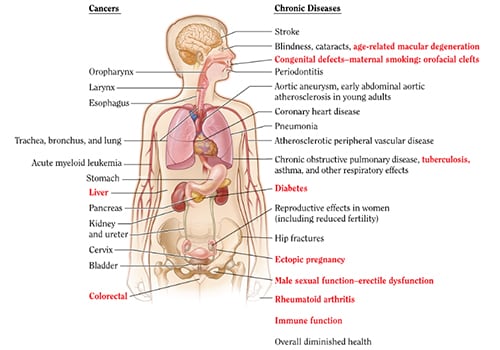
If nobody smoked, one of every three cancer deaths in the United States would not happen.
Quitting smoking lowers your risk for smoking-related diseases and can add years to your life.
Smoking and Death
Cigarette smoking is the leading preventable cause of death in the United States.- Cigarette smoking causes more than 480,000 deaths each year in the United States. This is nearly one in five deaths.
- Smoking causes more deaths each year than the following causes combined:
- Human immunodeficiency virus (HIV)
- Illegal drug use
- Alcohol use
- Motor vehicle injuries
- Firearm-related incidents
- More than 10 times as many U.S. citizens have died prematurely from cigarette smoking than have died in all the wars fought by the United States during its history.
- Smoking causes about 90% (or 9 out of 10) of all lung cancer deaths in men and women. More women die from lung cancer each year than from breast cancer.
- About 80% (or 8 out of 10) of all deaths from chronic obstructive pulmonary disease (COPD) are caused by smoking.
- Cigarette smoking increases risk for death from all causes in men and women.
- The risk of dying from cigarette smoking has increased over the last 50 years in men and women in the United States.
Smoking and Increased Health Risks
Smokers are more likely than nonsmokers to develop heart disease, stroke, and lung cancer.- Smoking is estimated to increase the risk—
- For coronary heart disease by 2 to 4 times
- For stroke by 2 to 4 times
- Of men developing lung cancer by 25 times
- Of women developing lung cancer by 25.7 times
- Smoking causes diminished overall health, increased absenteeism from work, and increased health care utilization and cost.
Smoking and Cardiovascular Disease
Smokers are at greater risk for diseases that affect the heart and blood vessels (cardiovascular disease).- Smoking causes stroke and coronary heart disease, which are among the leading causes of death in the United States.
- Even people who smoke fewer than five cigarettes a day can have early signs of cardiovascular disease.
- Smoking damages blood vessels and can make them thicken and grow narrower. This makes your heart beat faster and your blood pressure go up. Clots can also form.
- A stroke occurs when a clot blocks the blood flow to part of your brain or when a blood vessel in or around your brain bursts.
- Blockages caused by smoking can also reduce blood flow to your legs and skin.
Smoking and Respiratory Disease
Smoking can cause lung disease by damaging your airways and the small air sacs (alveoli) found in your lungs.- Lung diseases caused by smoking include COPD, which includes emphysema and chronic bronchitis.
- Cigarette smoking causes most cases of lung cancer.
- If you have asthma, tobacco smoke can trigger an attack or make an attack worse.
- Smokers are 12 to 13 times more likely to die from COPD than nonsmokers.
Smoking and Cancer
Smoking can cause cancer almost anywhere in your body:(See figure above)- Bladder
- Blood (acute myeloid leukemia)
- Cervix
- Colon and rectum (colorectal)
- Esophagus
- Kidney and ureter
- Larynx
- Liver
- Oropharynx (includes parts of the throat, tongue, soft palate, and the tonsils)
- Pancreas
- Stomach
- Trachea, bronchus, and lung
If nobody smoked, one of every three cancer deaths in the United States would not happen.
Smoking and Other Health Risks
Smoking harms nearly every organ of the body and affects a person’s overall health.- Smoking can make it harder for a woman to become pregnant and can
affect her baby's health before and after birth. Smoking increases risks
for:
- Preterm (early) delivery
- Stillbirth (death of the baby before birth)
- Low birth weight
- Sudden infant death syndrome (known as SIDS or crib death)
- Ectopic pregnancy
- Orofacial clefts in infants
- Smoking can also affect men's sperm, which can reduce fertility and also increase risks for birth defects and miscarriage.
- Smoking can affect bone health.
- Women past childbearing years who smoke have weaker bones than women who never smoked, and are at greater risk for broken bones.
- Smoking affects the health of your teeth and gums and can cause tooth loss.
- Smoking can increase your risk for cataracts (clouding of the eye’s lens that makes it hard for you to see) and age-related macular degeneration (damage to a small spot near the center of the retina, the part of the eye needed for central vision).
- Smoking is a cause of type 2 diabetes mellitus and can make it harder to control. The risk of developing diabetes is 30–40% higher for active smokers than nonsmokers.
- Smoking causes general adverse effects on the body, including inflammation and decreased immune function.
- Smoking is a cause of rheumatoid arthritis.
NOTICE TO LOAN APPLICANTS TO VIEW THEIR LOAN ALLOCATION RESULTS 2016/2017
NOTICE TO LOAN APPLICANTS TO VIEW THEIR LOAN ALLOCATION RESULTS
Kindly Click here to view your Loan allocation status. Please note that you will be required to use the four index number you used during your application.
NOTICE TO LOAN APPLICANTS TO VIEW THEIR LOAN ALLOCATION RESULTS 2016/2017
NOTICE TO LOAN APPLICANTS TO VIEW THEIR LOAN ALLOCATION RESULTS
Kindly Click here to view your Loan allocation status. Please note that you will be required to use the four index number you used during your application.
Monday, September 26, 2016
Heath Consultants
Heath Consultants Incorporated is a third generation family-owned
business that was founded in 1933 by Milton Heath Sr., who started out
providing line clearing services to New England utilities. In later
years Heath ended up researching and discovering what was causing the
death of trees in Massachusetts through what later became the first
known gas leak vegetation surveys. As the surveys proved highly
effective at detecting leaks, Heath’s business grew and evolving
customer needs led the company to expand and provide methane detection
systems for gas suppliers.
Since then, Heath has expanded its products and services with the goal of becoming the world leader in utility protection and damage prevention. From portable gas detectors and confined space monitors to pipe and cable locators, Heath strives to provide the utility industry with the most innovative and cutting-edge products and instruments.
Heath’s Services Business Unit serves the upstream, midstream, and downstream oil and gas markets. Our extensive experience with gas leak investigation and inspections, underground utility damage prevention, meter reading/services and our rigorous training programs make Heath the most trusted name in utility services.
Our engineering and marketing experts on our research and development team keep up with ever-changing market demands to provide state-of-the-art services and products to each of our customers
Since then, Heath has expanded its products and services with the goal of becoming the world leader in utility protection and damage prevention. From portable gas detectors and confined space monitors to pipe and cable locators, Heath strives to provide the utility industry with the most innovative and cutting-edge products and instruments.
Heath’s Services Business Unit serves the upstream, midstream, and downstream oil and gas markets. Our extensive experience with gas leak investigation and inspections, underground utility damage prevention, meter reading/services and our rigorous training programs make Heath the most trusted name in utility services.
Our engineering and marketing experts on our research and development team keep up with ever-changing market demands to provide state-of-the-art services and products to each of our customers
BREAKING NEWS:HIZI HAPA SIFA ZA KUJIUNGA NA CHUO KIKUU MWAKA WA MASOMO 2016/2017-TCU
Tanzania
Commission for Universities
 PUBLIC NOTICE
CHANGE OF PROCEDURES, REQUIREMENTS AND MINIMUM ADMISSION ENTRY QUALIFICATIONS FOR UNDERGRADUATE STUDENTS
1.0. Background
This is to inform
the General Public
and all Prospective applicants for admission into various undergraduate degree
programmes that, pursuant to section
5(1)(c)(i) of the Universities Act, Cap. 346 of the Laws
of Tanzania, the Tanzania Commission for Universities (TCU) is mandated to provide guidance
and monitor criteria
for admission to universities
in the United Republic of Tanzania. The minimum admission entry
qualifications currently in use were approved by the Commission in 2011.
2.0. Rationale for change of Minimum
Admission Entry Qualifications
PUBLIC NOTICE
CHANGE OF PROCEDURES, REQUIREMENTS AND MINIMUM ADMISSION ENTRY QUALIFICATIONS FOR UNDERGRADUATE STUDENTS
1.0. Background
This is to inform
the General Public
and all Prospective applicants for admission into various undergraduate degree
programmes that, pursuant to section
5(1)(c)(i) of the Universities Act, Cap. 346 of the Laws
of Tanzania, the Tanzania Commission for Universities (TCU) is mandated to provide guidance
and monitor criteria
for admission to universities
in the United Republic of Tanzania. The minimum admission entry
qualifications currently in use were approved by the Commission in 2011.
2.0. Rationale for change of Minimum
Admission Entry Qualifications
In recent
years, there have been concerns from different
stakeholders on the quality of
candidates being admitted to various universities, hence negatively affecting the quality of
training and the resultant output/graduates. Similarly, there are
concerns that by lowering the minimum points for admission into university
institutions, almost every candidate
with two principal passes is eligible
to join a university and therefore leaving
most of the middle level tertiary institutions without qualified students.
Tanzania
Commission for Universities
PUBLIC NOTICE
CHANGE OF PROCEDURES, REQUIREMENTS AND MINIMUM ADMISSION ENTRY QUALIFICATIONS FOR UNDERGRADUATE STUDENTS
1.0. Background
This is to inform
the General Public
and all Prospective applicants for admission into various undergraduate degree
programmes that, pursuant to section
5(1)(c)(i) of the Universities Act, Cap. 346 of the Laws
of Tanzania, the Tanzania Commission for Universities (TCU) is mandated to provide guidance
and monitor criteria
for admission to universities
in the United Republic of Tanzania. The minimum admission entry
qualifications currently in use were approved by the Commission in 2011.
In recent
years, there have been concerns from different
stakeholders on the quality of
candidates being admitted to various universities, hence negatively affecting the quality of
training and the resultant output/graduates. Similarly, there are
concerns that by lowering the minimum points for admission into university
institutions, almost every candidate
with two principal passes is eligible
to join a university and therefore leaving
most of the middle level tertiary institutions without qualified students.
3.0. New Minimum Admission Entry Qualifications
In view of
such concerns, the Commission has decided to raise the threshold for the
minimum entry points for admission to university education.
Thus from the 2016/2017 academic
year, the new Minimum Admission Entry Qualifications for
Undergraduate Students shall now be as follows:
NO.
|
CATEGORY OF APPLICANTS
|
MINIMUM
ADMISSION ENTRY QUALIFICATIONS
|
|||
1.
|
Completed A-Level studies before 2014
|
Two principal passes (Two Ds) with
a total of 4.0 points (where A = 5;
B = 4; C= 3; D = 2; E = 1).
|
|||
2.
|
Completed A-Level studies in 2014 and 2015
|
Two principal passes (Two Cs) with
a total of 4.0 points (where A = 5;
B+ = 4; B = 3; C= 2; D = 1).
|
|||
3.
|
Completed
A –Level studies from 2016
|
Two principal
passes (Two Ds) with a total of 4.0 points (where A = 5;
B = 4; C= 3; D = 2; E = 1).
|
|||
4.
|
Recognition of Prior Learning qualification
|
B+ Grade: where A
=75-100, B+ = 65-74,
B=50-64, C =40-49, D = 35-39,
F = 0-38.
|
|||
5.
|
Equivalent
applicants
|
At least four
O’-Level passes (Ds and above) or NVA Level III with less than four O’-Level passes
or equivalent foreign qualifications
as established by either NECTA
or VETA; AND
|
|||
i) At least a GPA of 3.5 for Ordinary Diploma (NTA Level 6); OR
|
|||||
ii) Average of B for Full Technician Certificate (FTC) (where A=5, B=4, C=3, and D=2 points); OR
|
|||||
iii) Average of
‘B+’ Grade
Teacher
Education; OR
|
for
|
Diploma
|
in
|
||
iv)
Average of ‘B+’ Grade for Health related
awards such as Clinical Medicine and others;
OR
|
|||||
v) A Distinction for unclassified diplomas and certificates.
|
|||||
vi) Upper Second Class for classified non-NTA
diplomas.
|
|||||
Subscribe to:
Posts (Atom)